
Public Diners
What are they?
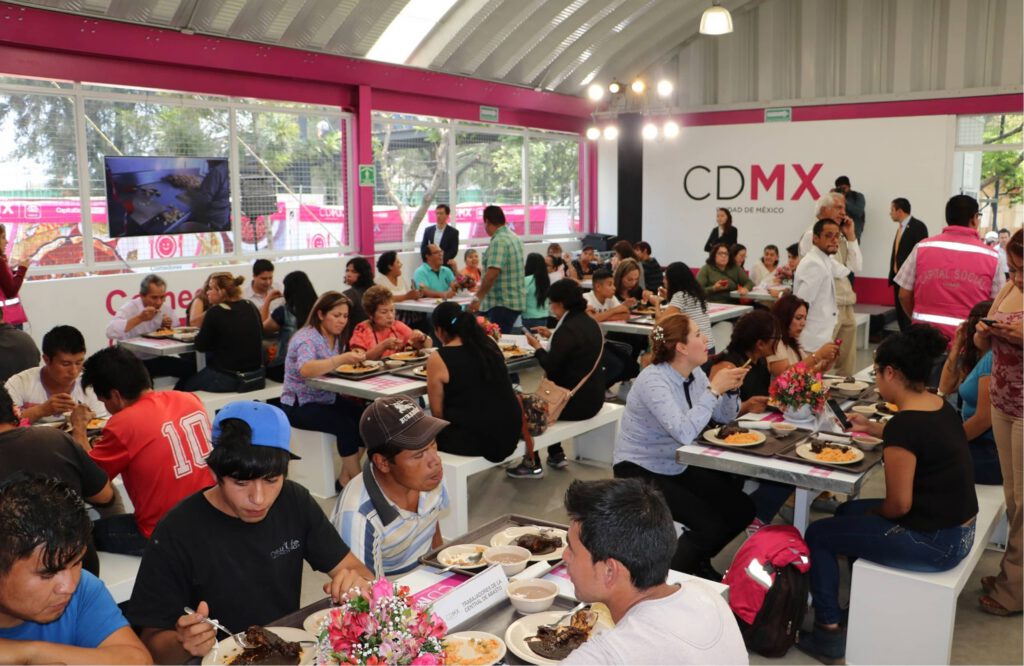
Public diners are restaurants that operate with state support. They form part of public infrastructure alongside parks, leisure centres, public transport, and libraries.
Public diners aren’t speciality bistros, but they also aren’t charitable soup kitchens. They are regular eating places that make it possible to eat out more than once a week without breaking our banks, our health or our climate.
Public diners are not another response to food insecurity – they are universal public infrastructure, like public transport, that improves everyone’s life.
Core principles
Public diners are defined by seven key characteristics. These characteristics, as well as how they should be practiced, have been co-designed with people.
1
State supported
State supported
Public diners operate with public funding or other forms of public support (for example, rent controls, tax breaks). This differentiates them from private restaurants and from charitable food provision.
Public diners are underwritten by state support. This can take a variety of forms: from capital and start-up grants, to regular subsidies, to support with amenities and supply chains. This makes them economically viable. While delivery models vary from full scale service provision to subcontracting delivery to external providers, there is a formal and ongoing relationship with the state.
Public diners are underpinned by law – an act of parliament or a byelaw – which spells out the state’s responsibilities towards them and the financial structure. Their recognition in law is what makes them part of public infrastructure. It also provides them with stability and improves standards over time.
2
Universal
Universal
Public diners are open to everyone. They are not targeted at, or exclusive to, any particular group. Public diners are there for everyone.
Much like public parks and libraries, they enhance the neighbourhoods they’re in. Some people love them and visit regularly; others – occasionally or not at all. But nobody feels like public diners are not for them.
Universalism says “we’re building this for all of us”. It’s the opposite of targeting a policy or institution at a particular group. Instead, universalism focuses on creating institutions and services that benefit each of us and society as a whole.
This principle underpins our approach to public infrastructure for a reason: in order to justify the investments we make from our taxes we need to ensure that the institutions we create are popular and seen as valuable. For services that operate a mixed economic model, like buses or leisure centres, that popularity leads to more income and reduction in the need for state subsidy. It’s a virtuous circle.
3
Democratic
Democratic
Public diners are democratic institutions. They have formal mechanisms for public scrutiny and participation.
Workers, customers and citizens are clear how they can influence the running of a public diner – directly or via the local authority. They are places where people are not food consumers – they are food citizens.
They also open up possibilities for public engagement – in the same way as museums, galleries or libraries do. They have the potential to be vibrant spaces which grow the enjoyment of good food in the community and in wider culture through events and pop-ups. They can also help to incubate start-up and micro businesses.
4
Affordable
Affordable
Public diners serve meals at low prices. They also have formal concessionary schemes to ensure everyone can eat there.
In a public diner, the customers pay for the meal; the government covers the rest. This keeps prices affordable for everyone – equivalent to a cup of coffee or a ready meal. For the government, it’s a cheap way to prevent more costly problems from occurring down the line.
To ensure their popularity and universality, public diners are always affordable. The price point doesn’t make you think twice and rivals the cost of a supermarket ready meal. Public diners don’t operate pay-as-you-feel solidarity schemes. Instead they offer subsidy mechanisms similar to bus passes, Best Start grants or Young Scot entitlement cards for groups that would particularly benefit from using them.
5
Real good food
Real good food
Public diners serve meals that taste good, celebrate local flavours, care for the planet and can be enjoyed by everyone.
Public diners models the right to food and good food culture. Food is delicious and reflects the tastes of the local community. The menu, and experience of dining, is nourishing and supports people’s wellbeing. It’s a place where ‘healthy’ and ‘tasty’ are not in competition. It’s a place which makes it easy for people to eat the food they enjoy and which keeps them healthy and well.
The food on the menu also serves a social purpose. The sourcing, at least in part, supports local and agroecological producers. The scale of the enterprise also means it can help to cope with and utilise food surpluses (such as agricultural gluts) that meet high quality standards. Public diners try to model and support the food supply chain transformation we need.
6
Appealing
Appealing
Public diners are regular restaurants. They are places that are convenient and appealing for everyone to eat at.
Public diners are attractive, informal, welcoming without being overbearing. They are places where regulars are recognised, and newcomers are welcome. The staff understand their role is to make sure diners feel comfortable and provide an experience you want to enjoy again and again.
They operate at scale, serving upwards of 100 meals a day. Public diners keep drawing you back with their food and their atmosphere.
7
Long-term
Long-term
Public diners are fixed parts of neighbourhoods. They are also fixed parts of the social safety net.
We all know where our local library, park or bus stop is. The same is true for a public diner. They become fixed features of our neighbourhoods, places which are reliably there and our service whenever we need or want it.
Thanks to state-subsidy they do not reply on short-term annual grant cycles and stay resilient to the pressures of the free market. In turn, people can grow to rely on them: either as everyday places to eat, or places to rely on during times when cooking at home is difficult – such as falling ill or having small children. This reliability is critical to ensuring public diners can function as third spaces, which enhance neighbourhoods and build social capital.